
School Closure Support
Please keep checking this page for tips and ideas to help you make educating your child at home fun and interesting for you both. We will try to add something new each day for you to try out!
A beautiful book all about the 2020 pandemic and the positives to come from a very difficult year! Very worthwhile sharing this with your children.
Anxiety support booklet for use in preparation of children returning to school in September
Government Leaflet for Parents about the return to school of all children in September
Getting Back to School Video for children
Godly Play from Sutton St James Baptist Church
Sue and Arnie have been busy producing a You-tube link for us containing their recording of a godly play session, specifically for the children of our school. These can be used as Religious Education sessions at home with the children or as a form of Assembly at home. Many thanks to Sue and Arnie for producing these for us. A new session will be added each week through this same link. Click on the link below to view this resource.
Mental Health
This is a very difficult time for everybody - adults and children alike. It can be difficult to adapt to the new way in which we are all having to live and parents are telling us that children are starting to miss their friends and some are beginning to become reluctant to do school work at home. We all have different feelings and cope in different ways using different strategies - and that is OK!
Below are some links to power-point lesson presentations and resources, taken from the PSHE Association, which can be used at home to support children in understanding their feelings. Please ensure that you read the Parents Guidance document before you complete the exercises with your children.
In addition to these lessons, we have added some tips and advice (taken from the Internet) to help your child recognise and cope with anxiety, some children's books explaining the virus and some work packs which could be completed at home.
We hope that you find some of these useful in supporting your child!
Tips for helping children deal with anxiety....
If your child is really struggling, here are some extra things that you can do.
- Whenever there is something scary in the news, we tell parents and children to ‘look for the helpers’. So, rather than focusing on the virus, focus on the nurses and doctors who are working really hard to help people get better. Look at the scientists who are working really hard to come up with a cure. Look at the cleaners who are working really hard to keep everywhere clean and germ-free. Everyone is working together to try to sort this problem out.
- Reassure them (and yourself) that is OK to feel worried. We all feel worried at times – it’s a normal human emotion. But if it really does get too much and you feel as if they are constantly worrying and looking for reassurance, you could try ‘worry time’. This is a technique that we use with kids who are real worriers. It’s where the parent and the child agree a time each day that will be ‘worry time’. Say, 5pm, just before dinner. Then, for 20-30 minutes, sit down with your child and let them worry to their heart’s content. Your job is mostly to listen. If there is a worry that you can easily resolve, do so. But, mostly listen and be sympathetic. Then outside of that time, when your child starts worrying, gently ask them to save the worry to ‘worry time’. It can be a good way of getting children to start feeling a bit of control over their worries.
- Do something positive to help the situation. Helping other people is a really good way of dealing with a bad situation. It releases feel-good chemicals in our brain and makes us feel more in control. So, with your child, think of what you can do to help other people. Could you make a small donation to the local foodbank (most take cash online, if your own supplies are running low)? Can you phone an elderly neighbour and offer to get shopping for them? Do ask your child if they have any ideas.
- Do some meditation or relaxation exercises. There are tons of these on the internet. Find something aimed at children and then do it together.
- Do something fun! Fun is a great distraction – play a game, bounce on the trampoline, bake a cake. Whatever floats your child’s boat.
Tips and advice for helping children to cope with anxiety
Guidance for parents
Year 1 and Year 2 - Power-point presentation and resources
Year 3 and Year 4 - Power-point presentation and resources
Year 5 and Year 6 - Power-point presentation and resources
Books for children explaining COVID-19
Work packs to support children in managing anxiety / recognising when they are feeling anxious - these could be completed with children at home.
Phonics support
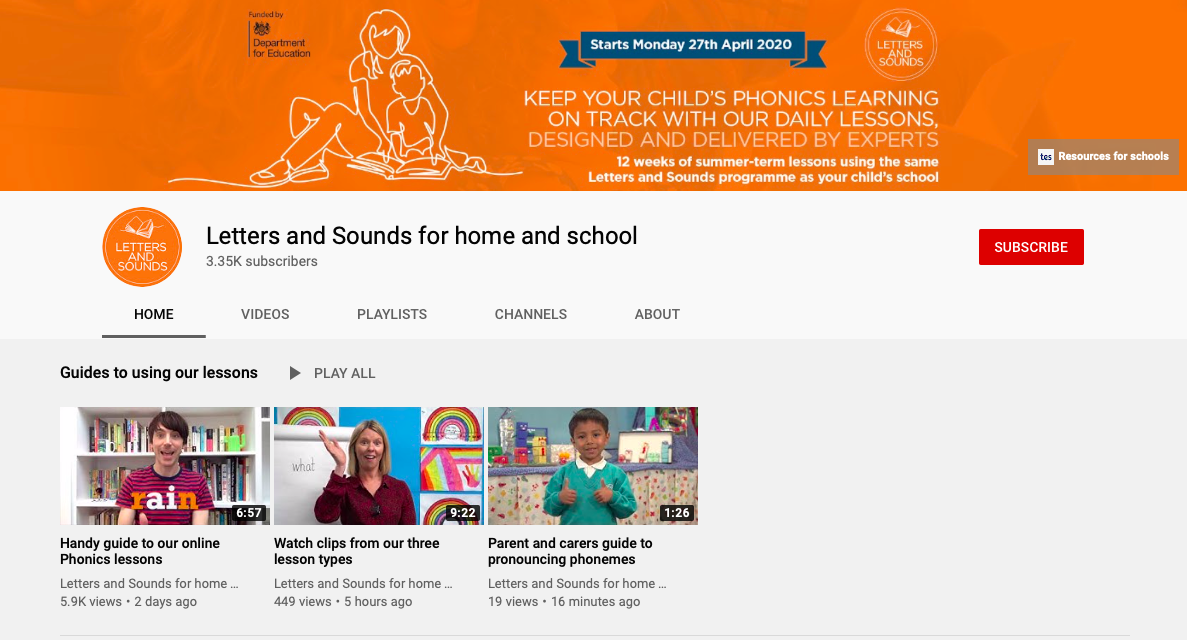
The Department for Education is starting its own Youtube channel. I will have daily videos to support phonics learning for the phases that children should be learning at this time of year in Reception and Year 1.
Videos begin on Monday 27th April, please click the link below.
Recipe ideas for ingredients in FSM food hampers this week
- BananaPancakes.pdfPDF File
- CheesyPastaBake.pdfPDF File
- SausagePie.pdfPDF File
- CrustlessBacon&CheeseQuiche.jpgJPG File
- PotatoWedges.jpgJPG File
- TomatoSoup.jpgJPG File
- CheesyPotatoShells.jpgJPG File
- GrilledSausageWap.jpgJPG File
- OatCookies.jpgJPG File
- PizzaRoll (2).jpgJPG File
- EasyCheesyVeggiePasta.jpgJPG File
- MegaMildChilliMinceRice.jpgJPG File
- BreakfastBeanBurito.jpgJPG File
- EggyBreadBaconSandwich.jpgJPG File
- SimpleJellyCustardTrifle.jpgJPG File
- CheesyPotatoCake.jpgJPG File
- AppleIceLollies (2).jpgJPG File
- SausageBeanCasserole.jpgJPG File
- EasyPeasyPizza.jpgJPG File
PE Recording Sheet
Coronavirus advice and information leaflet which can be shared with children.
Online Safety Resources
Set a routine which includes time for work and fun - and then stick to it Monday -Friday. Routine is essential for children and helps to support positive behaviour. See below for some suggested timetables and adapt one to make it work for you and your child.
Adapted from Mr Richardson's suggested timetable.
|
Before 9am |
Wake Up |
|
|
9 – 9:30am |
Physical Fitness & The Morning Challenge |
|
|
9:30 – 10:30am |
English |
|
|
10:30 – 11:00am |
Exercise & Snack (fruit) |
|
|
11 – 12pm |
Maths |
|
|
12 – 1pm |
Lunch & Exercise |
|
|
1 – 1:30pm |
Reading |
|
|
1:30 – 2pm |
Spelling and Maths Shed |
|
|
2 – 3pm |
Wider World Knowledge |
|